 Definitions
Trim:
Definitions
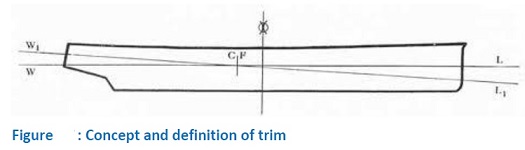
Trim: Trim is normally defined as the difference between the aft draft and the forward draft:
Trim = TA-TF
Where:
TA =
Aft draft (m),
TF =
Forward draft (m)
When the trim is positive, it means that the vessel's stern is more inside the water than forward. Accordingly, positive trim means trim to aft, and negative values of trim means trim to forward. The concept of trim is shown in Figure .
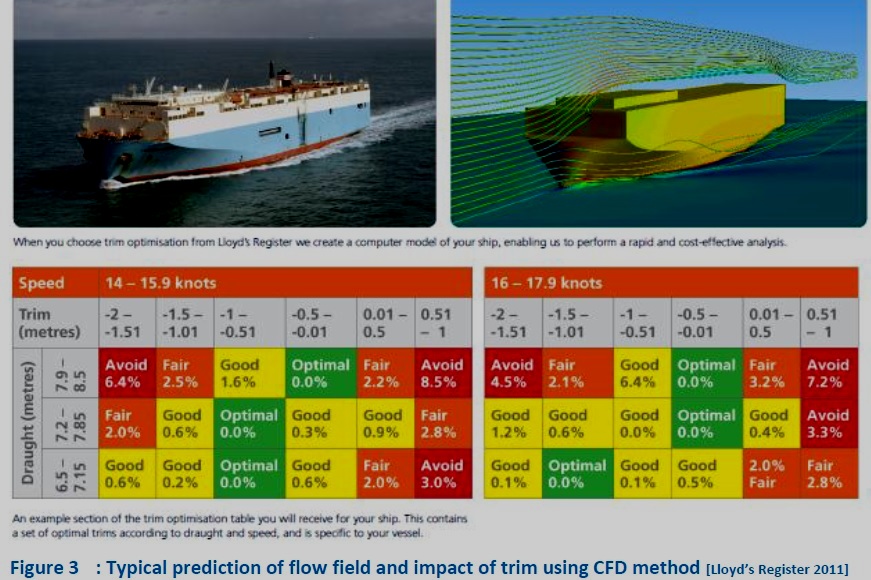
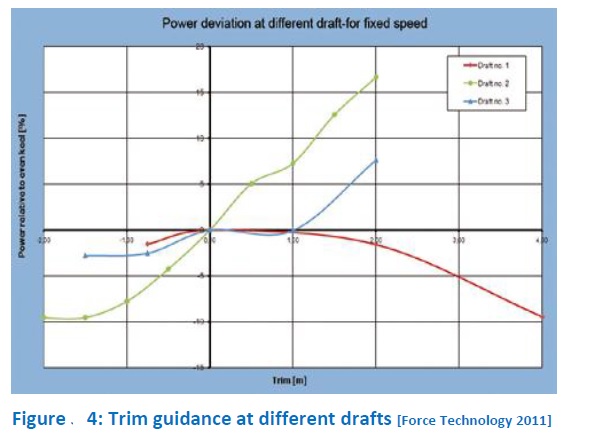
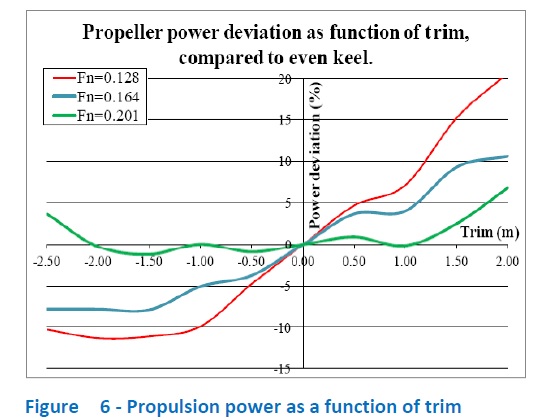
Optimum trim: Optimum trim refers to a ship's trim under which the required propulsive power is minimal for the specific operational speed and a draft of the vessel.
Load planning:
The ship loading plan specifies the loading levels and how the loads should be distributed in different cargo spaces. The load planning should be done by considering corresponding regulations (e.g., load line convention) but above all the ship stability. The process of
loading of a ship is with port's staff and loading superintendents, but the master or chief officer is ultimately responsible for all the loading and unloading operations.
Loading computer:
A loading computer system is a computer-based system for the calculation and control of ship loading conditions for compliance with the applicable stability requirements and longitudinal and local strength requirements. The ship-board loading computer system consists of software (calculation program) and an appropriate computer (hardware).
Even keel refers to ship condition when the draft of a ship fore and aft is the same. In other words, even keel refers to zero trim.
Static trim: This refers to a ship's trim when the ship is in still water (not moving). In this case, the difference between the aft and forward drafts; mainly dictated by the ship's cargo, ballast, fuel on board, etc. distributions.
Dynamic trim: This refers to a ship's trim when the ship is underway and moving. It is different from static trim due to the ship sinkage phenomena.
The sinkage level is characterized by a dynamic sinkage at the forward and a dynamic sinkage at the aft of the ship. Usually, the forward sinkage is more than the aft sinkage and is a function of ship speed as well. Dynamic trim thus is static trim plus trim changes due to ship sinkage while underway.
Physics of trim
A ship's resistances and its trim are closely related to each other. It is because trim could change parameters that impact the hydrodynamic performance of a ship. The high impact of trim on ship performance is well known in particular for container ships and RoRo vessels. Large fuel savings are claimed due to changes to the ship trim.
The possible explanations for the relatively large dependencies of ship performance on the trim could be attributed to the following impacts of trim [Force Technology 2011]:
- Changes to wave resistance
- Changes to wetted surfaces and thereby the frictional resistance.
- Changes to form resistance due to transom submergence
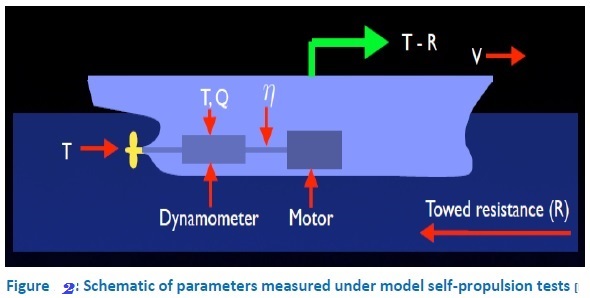
- Changes to various propulsion coefficients including:
i) Resistance coefficients
ii) Thrust deduction
iii) Wake fraction
- Changes to propulsive efficiencies including:
i)Relative rotative efficiency.
ii) Propeller efficiency
On fast container ships and RoRo vessels, there is much to be gained by introducing the correct (optimum) trim. However, a reduction in fuel consumption due to changes to trim might be achieved even on tankers and bulk carriers [Force Technology 2011].